




After almost two decades in the public eye, Scha Alyahya speaks about ageing, motherhood, self-care and learning to separate confidence from other people’s expectations.
There is a particular kind of confidence that comes with no longer needing to prove who you are.
For Scha Alyahya, that confidence has been built gradually and publicly. Malaysians first came to know the Sungai Petani-born star after she won Dewi Remaja in 2006.
It was a beginning that soon led to acting, hosting and the role of Dania in Awan Dania, the television series that made her one of the country’s most recognisable faces.
Nearly two decades later, Scha is no longer simply the newcomer audiences watched, finding her place in entertainment. She has since then become a fixture in Malaysian popular culture: an actress, television host, entrepreneur and fashion personality whose presence has extended from local screens to the runway at Dubai Fashion Week.
Away from the cameras, life for Scha has evolved just as significantly.
She is a wife to Awal Ashaari and mother to their daughters, Lara Alana and Lyla Amina – roles that have unfolded alongside a career lived largely in public.
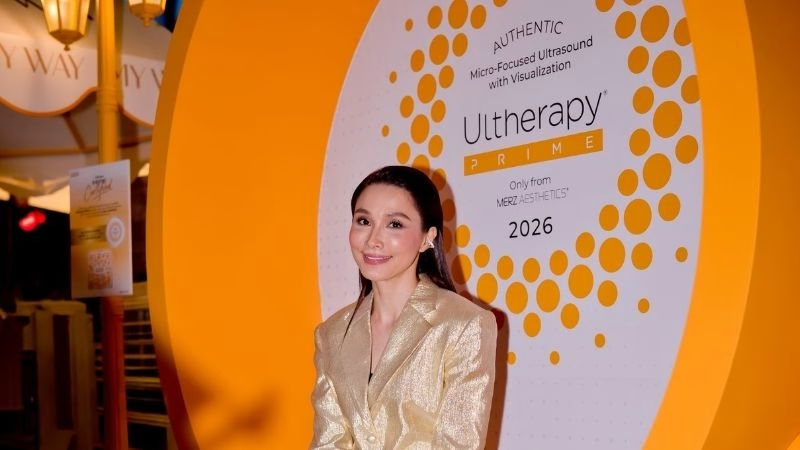
In June 2026, Scha was announced as Malaysia’s first Ultherapy PRIME Brand Ambassador as part of the “See My Skin, Lift My Way” campaign, which celebrates individuality and a more personalised approach to aesthetic care.
It feels like a fitting partnership for someone whose idea of beauty today is less concerned with holding on to an earlier version of herself and more focused on feeling healthy, assured and recognisably herself.
Amid the many roles she continues to balance, Scha made time to speak with us about the way her relationship with beauty has matured, the realities of self-care and what she hopes her daughters will understand about their own worth.
Beauty After Almost Two Decades on Camera

Scha has spent much of her adult life being looked at.
From magazine covers and television sets to red carpets and fashion campaigns, appearance has naturally been part of the job. In her early years, she felt a responsibility to maintain a particular image for the camera. Today, the way she defines beauty reaches much further than that.
“When I first started, beauty was something I thought I had to maintain for the camera. It was very much about how I looked. But today, beauty feels much more personal. Its about how I carry myself, how I treat people, how healthy I feel, and the confidence that comes from knowing who I am.”
For those who have followed Scha since her early acting days, that evolution feels visible.
I’ve learned that beauty evolves with every stage of life, and I think thats something to celebrate rather than fear.
The boldness and presence that first drew attention to her have not disappeared. They have simply settled into something more assured. At this point in her life, beauty appears less tied to being admired and more closely connected to how comfortably she inhabits her own identity.
Learning Not to Carry Every Opinion
Fame has given Scha opportunities, longevity and a remarkably loyal audience. It has also meant experiencing life under a level of observation most people never have to consider.
Changes in her appearance can become headlines. An outfit can prompt thousands of comments. A single photograph may be examined by people who know the image but not necessarily the person within it.
Scha has learned that surviving that kind of visibility requires boundaries, particularly between what others say and what she chooses to believe about herself.

I’ve realised that perfection doesn’t exist.
“There will always be opinions, especially on social media, but I have learned not to let them define how I feel about myself. I focus on being the healthiest and happiest version of me, rather than chasing impossible standards. The people who matter know who you are beyond your appearance, and that’s what keeps me grounded.”
It is a lesson that likely becomes clearer with time.
Public opinion moves quickly. The people who know her beyond the screen such as her family, children and those who have remained close through different stages of her life, offer a more reliable reflection.
The goal, as Scha puts it, is no longer perfection. It is health, happiness and knowing which voices deserve to matter.
Self-Care Between Work and Motherhood
Scha’s life may appear polished from the outside, but her idea of self-care is grounded in realities familiar to many working mothers.
It does not always involve a perfect routine or an entire day set aside for herself.
Often, it is found in ordinary habits: rest, water, movement or a quiet moment before everyone else needs something.
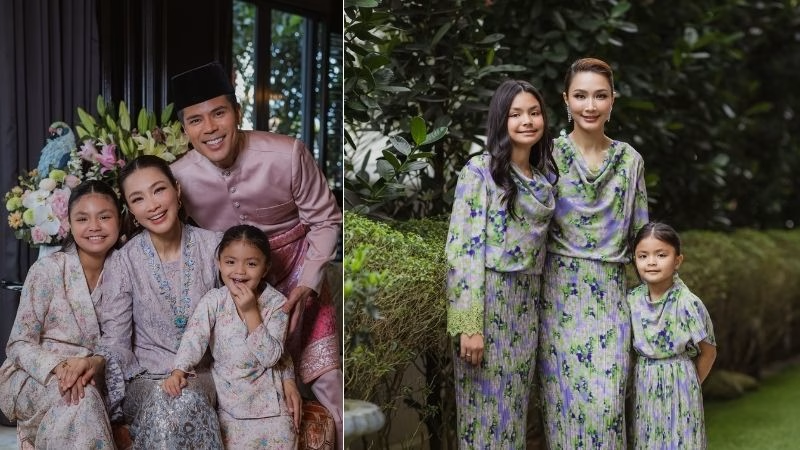
“Self care doesnt always mean spending hours at a spa. Sometimes its as simple as getting enough sleep, staying hydrated, squeezing in a workout, or enjoying a quiet cup of coffee before the house gets busy.
That quiet cup of coffee before the house becomes busy may be the most relatable detail of all.
“I also believe in making time for treatments that help me feel refreshed because taking care of myself allows me to show up better for my family and my work.”
For many mothers, self-care has to fit between school routines, professional responsibilities and the needs of the household. Scha’s answer does not romanticise that reality, nor does it suggest that women must earn the right to look after themselves only after everything else is complete.
Instead, she sees care as part of what enables her to remain present.
There are days when it means sleeping properly or finding time for a workout. At other moments, it may involve a treatment that helps her feel restored. Neither requires justification.
Knowing What She Is Saying Yes To
Having spent years working in beauty and fashion, Scha is familiar with a landscape that constantly introduces something newer, faster or more transformative.
Her approach, however, is not driven by novelty.

Safety always comes first. I want to know if there’s proper clinical research behind it, whether it’s suitable for my skin, and if its performed by qualified professionals. I also prefer treatments that enhance what I already have rather than completely changing the way I look.
That final distinction says a great deal about where she is now.
Enhancement, for Scha, is not an attempt to erase every sign of experience or return to the face she had when she first entered the industry. It is a way of caring for herself without losing the features and character that make her recognisable.
In an era of fast-moving beauty trends and increasingly standardised faces, choosing to still look like yourself can feel like its own statement.
Ageing Without Treating It as a Defeat
Scha turned 43 in May 2026. She has now spent close to half her life in an industry that places immense value on youth.
Yet her attitude towards ageing is not shaped by panic or denial.

“Aging is a privilege, and there is absolutely nothing wrong with wanting to look after yourself along the way. Taking care of your skin doesnt mean you’re trying to stop aging, it means you are respecting your body and investing in your wellbeing.
It is a perspective with room for nuance.
The goal shouldn’t be to look 20 forever, but to look and feel your best at every age.
Women are often pressured to choose a side. Either they must embrace ageing so completely that any interest in aesthetic care is seen as insecurity, or they must treat growing older as a problem requiring constant correction.
Scha’s position sits comfortably between those extremes.
She is not trying to deny the years behind her. Those years contain the career she built, the family she created, the difficult periods she survived and the certainty she has gradually gained.
Looking after herself does not require wishing any of that away.
The Lessons She Wants Her Daughters to Carry
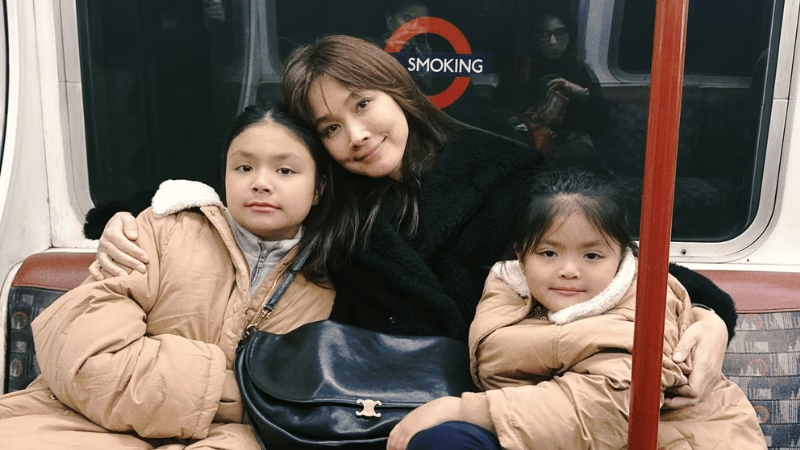
The conversation around beauty becomes even more personal when it turns to Lara and Lyla.
Scha’s daughters are growing up with a mother whose image is familiar to millions. They are also growing up in a digital world where beauty standards are no longer confined to magazines, television or advertising.
They appear constantly through filters, trends, algorithms and the seemingly effortless lives presented online.
Scha cannot remove those influences entirely. What she can do is give her daughters a stronger foundation from which to meet them.
“I hope they grow up knowing that their value is not measured by likes, filters, or how closely they fit someone else’s idea of beauty. I want them to understand that confidence comes from kindness, integrity, and believing in themselves.”
It is not a rejection of beauty, she emphasises.
“If they choose to wear makeup or have a skincare routine, I want it to be because it makes them feel good, not because they feel pressured to meet someone else’s expectations.”
Scha understands that makeup can be enjoyable and skincare can become a meaningful form of personal care. What she wants her daughters to recognise is the difference between making those choices freely and feeling that they must alter themselves to deserve approval.
Confidence, as she hopes they will learn, has to be built somewhere deeper.
Still Scha, Just More Certain

When Scha first became famous, beauty was part of the work. It was something prepared for cameras, maintained for appearances and inevitably measured through public response.
Today, it occupies a different place in her life.
Beauty can still include fashion, skincare and treatments that help her feel refreshed. But it also lives in good health, sufficient rest, kindness, integrity and the confidence to let other people’s opinions pass without carrying every one of them home.
Perhaps that is the clearest sign of how Scha has evolved.
She is not attempting to remain exactly as audiences first remember her, nor is she trying to become unrecognisable in the pursuit of reinvention.
She is simply allowing herself to move forward, older, more grounded and increasingly comfortable defining beauty on her own terms.
Note: Unless stated otherwise, all images in this article is credited to Scha Alyahya.
Disclaimer: This article is for general entertainment and public interest purposes only. Information is based on publicly available reports at the time of publication.